

In 2022, AI-assisted cheating was a fringe concern — debated in forums and dismissed as theoretical. By 2025, it had become the defining challenge in online assessment security.
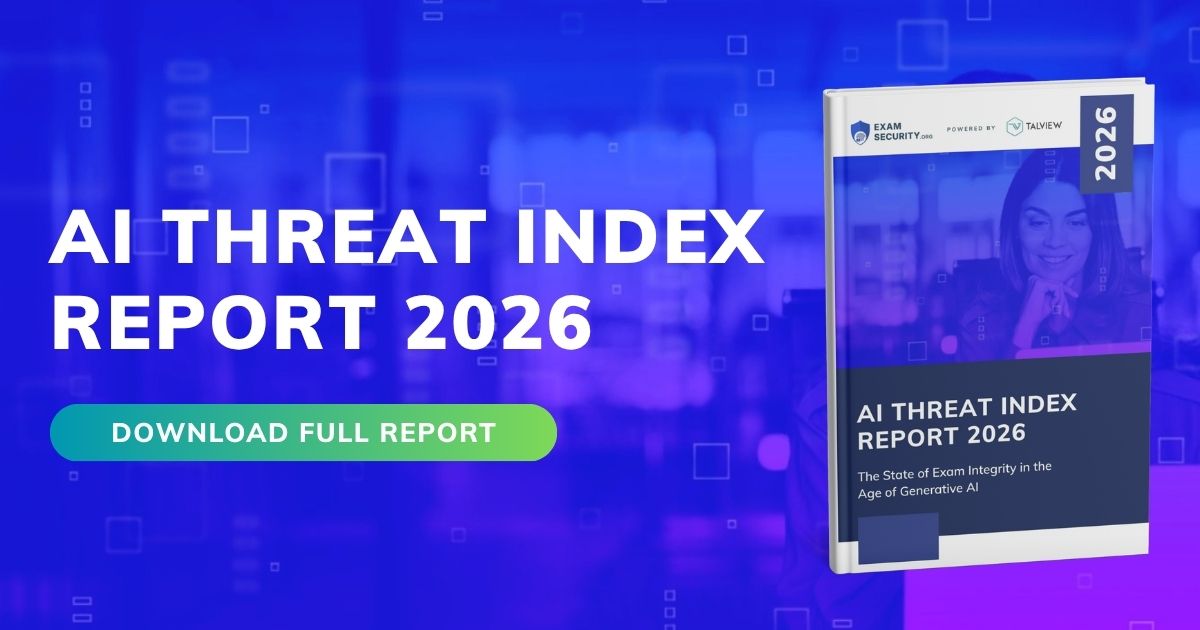
The AI Threat Index Report 2026 documents this escalation with verified data. At one major certification body, AI-related academic integrity incidents surged by over 340% in a single year. In the UK, more than 7,000 AI-assisted cheating cases were flagged across a single academic cycle. Perhaps most strikingly, 88% of test-takers in a recent industry survey admitted to using AI tools during assessments — not occasionally or experimentally, but routinely, during live exams.
These are not outliers. They are the new baseline for exam integrity risk in 2026.
How AI Cheating Methods Have Evolved Beyond Traditional Proctoring
The traditional model of online exam security — lockdown browsers, live proctors, webcam monitoring — was designed to catch a candidate glancing at their phone or opening a new browser tab. That threat model is now obsolete.
Modern AI tools can generate contextually accurate answers to complex exam questions in under three seconds. They operate invisibly on secondary devices, run through transparent screen overlays, and can be controlled via earpiece with no visible presence on a webcam feed. Some candidates are deploying multi-agent AI setups — one model generating answers, another reviewing them — while the camera sees nothing unusual.
The AI Threat Index Report 2026 identifies four distinct AI cheating vectors now in active use across online assessments:
- Screen-reader AI injection — AI tools that read exam content and generate answers in parallel
- Prompt-based answer generation — candidates feeding questions directly into LLMs mid-exam
- Synthetic identity bypass — using deepfakes or AI-generated profiles to defeat identity verification
- AI-augmented credential fraud — post-exam manipulation of results or records using AI tools
Each vector requires a different detection approach. Most current online proctoring systems are built for none of them.
Real Incidents, Real Consequences: What the Data Reveals
Awareness of AI exam fraud is no longer enough — the impact is already here. The report documents 14 verified incidents from the past 16 months spanning professional certification, academic, licensing, and regulated assessment environments.
These include a coordinated AI cheating breach affecting over 1,200 candidates in a single exam sitting, a licensing authority that invalidated an entire exam cohort following post-hoc AI detection analysis, and a major online certification platform that settled claims with test-takers wrongly flagged by its own proctoring system.
The shared consequence across all incidents: eroded trust in credentials, significant legal exposure, and lasting reputational damage for the institutions involved. In regulated professions, the risk is even more direct — unqualified practitioners holding legitimate-looking licenses pose a genuine public safety concern.
What Actually Works: Evidence-Based Approaches to AI Exam Security
The report doesn't stop at documenting the problem. It synthesizes emerging best practices from institutions that are effectively responding to AI integrity threats.
Behavioral biometrics, continuous identity verification, and AI-native anomaly detection are proving to be the most reliable countermeasures against AI-assisted cheating. Institutions that deploy layered detection — combining device signals, typing and response-pattern analysis, and behavioral modeling — report detection rates three to four times higher than those relying on traditional online proctoring alone.
The critical shift: reactive detection is no longer sufficient. Leading institutions are moving toward proactive integrity architecture — designing assessments and delivery environments where AI assistance is either detectable at the point of attempt or neutralized through assessment design itself.
Download the AI Threat Index Report 2026
The AI Threat Index Report 2026 is a research brief built for exam security professionals, certification bodies, assessment designers, and institutional decision-makers. It includes:
- Verified incident analysis from the past 16 months
- Sector-by-sector AI threat data and benchmarks
- Regional breakdowns of AI cheating patterns
- A five-year forecast model for AI integrity risk
- Practitioner-sourced guidance from leaders actively solving this problem
If AI exam integrity is on your radar — or needs to be — this report gives you the evidence base and strategic framing to act decisively.
Download the AI Threat Index Report 2026 — Free →
No fluff. Just the data and analysis you need to stay ahead of the fastest-growing threat in online assessment security.