
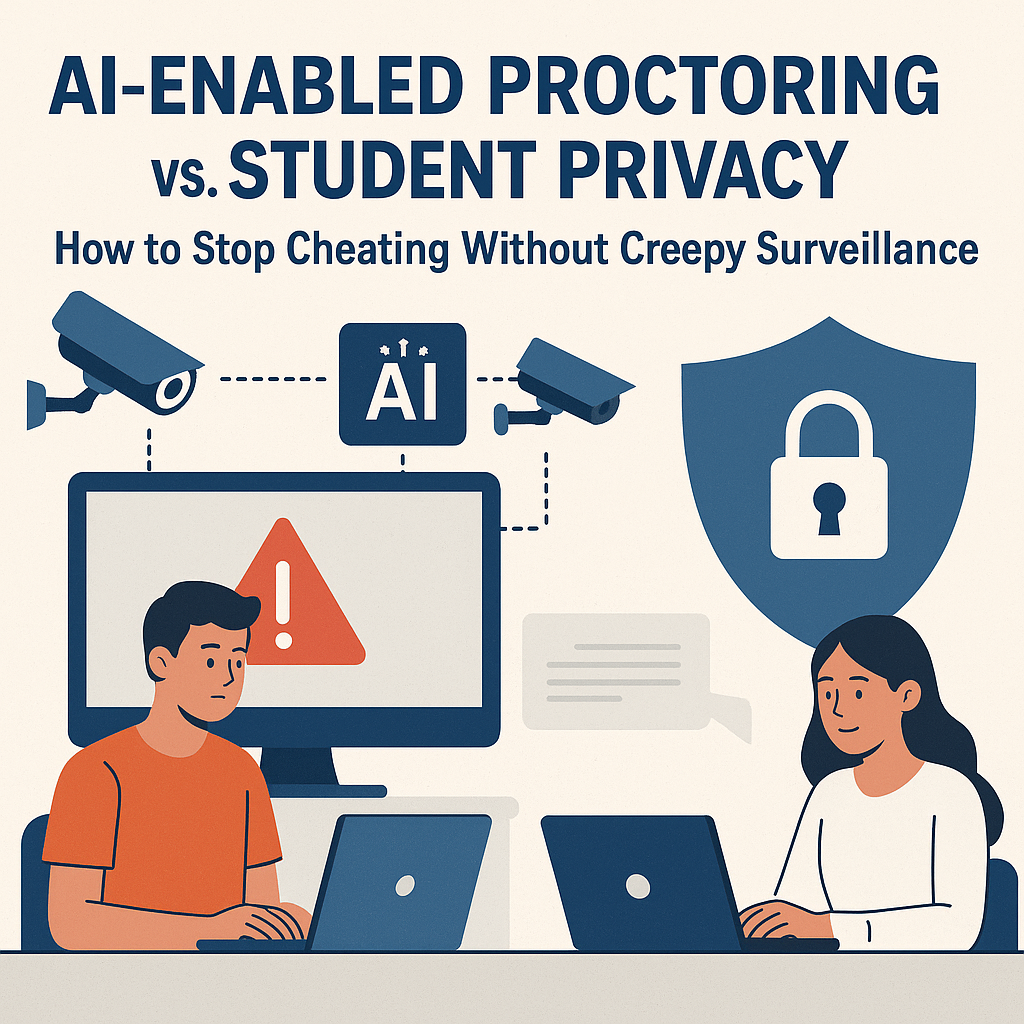
AI-Enabled Proctoring vs. Student Privacy: How to Stop Cheating Without Creepy Surveillance
Online exams are now core infrastructure for universities, credentialing bodies, and professional programs. But as more high-stakes assessments move online, the stakes for exam integrity rise too. Institutions are under pressure to prevent cheating, defend the value of their credentials, and reassure accreditors that standards have not slipped.
AI-enabled proctoring promises help. Algorithms can flag suspicious behaviors at scale, detect patterns in exam data, and provide integrity metrics that human invigilators would never see. At the same time, many students and faculty are deeply uncomfortable with what some tools actually do: constant webcam monitoring, gaze tracking, and micro-expression analysis that feels more like surveillance than assessment.
You do not have to choose between integrity and privacy. The real question is not "AI proctoring: yes or no?" It is "What kind of AI-enabled exam security do we want, and where do we draw the line?"
This post explores how to use AI-enabled proctoring to stop cheating without creepy surveillance. We will look at the problems with first-generation tools, what a privacy-by-design approach looks like, and how exam security analytics can give you better results with less intrusive monitoring.
Why first-generation AI proctoring broke trust
When institutions first turned to AI-enabled proctoring during emergency remote teaching, the primary focus was on quickly replacing physical invigilators. Many solutions tried to approximate the exam hall through the camera:
- Continuous face and gaze tracking to see if the student "looked away"
- Automated suspicion scores based on micro-expressions and head movements
- Strict rules about keeping hands, eyes, and face in frame at all times
On paper, this looked like stronger security. In practice, it created a series of serious problems:
First, high false positives. Ordinary human behavior was frequently flagged as "suspicious." Looking away to think, reading from the screen, stretching, or responding to noise in the room all triggered alerts. Neurodivergent students, students with disabilities, and students in less controlled home environments were disproportionately impacted.
Second, deep privacy concerns. Constant face and eye tracking in a personal space feels invasive, especially when the criteria for flags are opaque. Students reported feeling like suspects rather than learners. Headlines and social media amplified the perception of remote proctoring as "spyware".
Third, legal and regulatory risk. In several jurisdictions, detailed biometric monitoring and storage of facial data attracted the attention of data protection authorities. Institutions found themselves answering uncomfortable questions about what data was being collected, how long it was kept, and who could access it.
Fourth, erosion of trust. When students and faculty believe that proctoring is primarily about policing rather than protecting the value of a qualification, buy-in collapses. That makes it harder to sustain any integrity initiative, no matter how well designed.
The core lesson: simply pointing more cameras at students and adding more "AI suspicion scores" is not a sustainable strategy.
What AI-enabled exam security should actually do
A more mature view of AI-enabled proctoring focuses less on staring at faces and more on understanding exam behavior in context. Instead of treating the webcam as the single truth source, modern exam security analytics take a multi-signal approach:
- How the exam is taken: timing per question, navigation patterns, answer changes
- Where and on what it is taken: device fingerprints, IP addresses, and location signals
- How candidates behave as a group: response similarity and performance clusters
- How items behave over time: sudden shifts in difficulty and exposure
The goal is not to catch students blinking. The goal is to identify patterns that are highly unlikely to occur in a fair exam. Examples include:
- A subset of candidates completing complex questions significantly faster than cohort norms
- Groups of students with near-identical response patterns on hard items
- Multiple candidates appearing to sit exams from the same unusual environment
- Item banks that suddenly shift from discriminating performance to near-perfect scores in specific cohorts
These patterns are difficult for a single human invigilator to spot, but they are exactly what modern exam security analytics and AI are good at surfacing.
Where to draw the line: a privacy-by-design approach
To use AI-enabled proctoring without creeping into surveillance territory, institutions need a privacy-by-design mindset. That means deliberately deciding what to measure, why to measure it, and how to govern it.
Start with data minimization. Collect only the signals required to achieve clearly defined integrity objectives. If device and network signals, timing data, and cross-candidate analytics can give you strong evidence, there may be no need for continuous facial analysis. Some institutions retain video as a secondary, human-reviewable source rather than as the primary input to automated suspicion scores.
Be transparent with candidates. Before exams, clearly explain what data is collected, how it is used, and how long it will be stored. Provide practice exams in the same environment so students can see the system in action without high stakes. Transparency reduces anxiety and surfaces genuine issues early.
Keep humans in the loop. AI can rank risk and surface anomalies; humans should still make decisions. When a pattern looks concerning, integrity officers or instructors should be able to review context, examine related evidence, and decide on appropriate action. Automated penalties based only on algorithmic flags are a recipe for mistakes and appeals.
Design for fairness and accessibility. Test your exam security setup against diverse student profiles and environments. Where possible, offer alternatives or accommodations for candidates who cannot use standard setups. For example, a student with certain motor or visual impairments may trigger different behavioral patterns that analytics should account for.
Ensure auditability. Exams do not end when the last student submits. A robust integrity program includes the ability to review alerts, understand why candidates were flagged, and provide a clear evidence trail in case of appeals or regulatory review.
Examples of less-creepy, more effective AI use
What does privacy-respecting AI in exam security look like in practice? Consider these scenarios:
Instead of recording and analyzing facial micro-movements, an institution uses AI models to detect improbable patterns in answer timings and navigation. Very fast completion on difficult sections, combined with consistency across a group of candidates, triggers a deeper review. Webcam footage, if present, is used as contextual evidence rather than the primary detection signal.
Instead of trying to infer "stress" from facial expressions, a certification body uses analytics to monitor item-level performance over time. When a subset of questions suddenly becomes much easier for candidates from one region or provider, it investigates potential content leaks and retires or refreshes compromised items.
Instead of relying on a single proctoring mode, a university combines light-touch identity verification at the start of an exam, browser and environment telemetry during the exam, and cross-exam integrity dashboards after the exam. Students understand that the system looks for patterns of unfair advantage, not for normal human behavior.
In each case, the emphasis shifts from invasive observation to informed pattern recognition.
Questions to ask your AI proctoring vendors
If you are evaluating AI-enabled proctoring solutions today, you can use privacy-by-design principles to guide your vendor conversations. Useful questions include:
- What data do you actually collect, and which signals are most important to your detection models?
- How reliant are you on continuous facial and gaze tracking versus behavioral and environmental analytics?
- How do you measure and report false positives and false negatives, especially for different student populations?
- What controls do institutions have over data retention, access, and deletion?
- How are AI-generated alerts reviewed by humans before any action is taken?
- How do you support accessibility and accommodations, and how do you prevent bias against particular groups?
Vendors who focus on multi-signal analytics, transparency, and human review are more likely to support a sustainable, defensible integrity program than those who rely on opaque AI scores and as much webcam data as possible.
Balancing integrity, privacy, and trust
Ultimately, AI-enabled proctoring is a tool. It can be used in ways that support academic integrity, respect student privacy, and build long-term trust—or in ways that undermine all three.
Institutions that get this right tend to:
- Treat AI as an assistant to human judgment, not a replacement
- Design exam security as part of a broader integrity culture, not a standalone police force
- Use data thoughtfully, collect only what they need, and explain why
- Continuously review and adjust their approach as threats, tools, and expectations evolve
The stakes are high. Cheating and fraud genuinely threaten the value of credentials and the fairness of selection processes. But so does a loss of trust in how assessments are conducted.
The opportunity for higher education and credentialing programs is to adopt AI-enabled exam security that is both robust and respectful. That means moving beyond face-tracking surveillance toward analytics-driven insight, clear governance, and partnership with students.
You can stop cheating without creepy surveillance. It starts with deciding what kind of integrity story you want your institution to tell—and making sure your AI tools support that story, not undermine it.
FAQs
Why did early AI proctoring tools generate so much controversy?
Many first-generation AI proctoring tools relied heavily on continuous webcam monitoring, gaze tracking, and opaque suspicion scores. This led to high false positives, privacy concerns, legal scrutiny, and a feeling among students that they were being surveilled in their own homes.
Can we use AI for exam security without recording faces the entire time?
Yes. Modern exam security approaches can focus on non-biometric signals like timing, navigation, device fingerprints, IP addresses, and cross-candidate patterns. Video can be optional or used only as contextual evidence, rather than as the primary detection source.
How does a privacy-by-design approach change AI-enabled proctoring?
Privacy by design means collecting only the data needed for clearly defined integrity goals, being transparent with candidates, keeping humans in the loop for decisions, designing for fairness and accessibility, and ensuring that systems are auditable and defensible.
What metrics should we look at to evaluate the impact of AI proctoring?
Useful metrics include rates of confirmed integrity incidents, false-positive and false-negative rates, item-level performance changes over time, student satisfaction and complaint rates, and how often AI flags lead to human-validated issues.
How can institutions communicate about AI proctoring without causing panic?
Start by emphasizing the goal—protecting the value of qualifications and fairness for honest students. Explain clearly what data is collected and how it is used, provide practice exams, involve student and faculty representatives in policy design, and be open about how decisions are made when issues arise.