

In just a few years, online exams have gone from a contingency plan to a permanent part of higher education and professional certification. At the same time, the cheating landscape has changed dramatically. Where once you worried about open notes or messaging apps, you now have to contend with deepfakes, synthetic voices, and professional proxy testers using AI to stay invisible.
If your organization still relies on basic webcam monitoring and honor codes, you are already behind the threat curve.
In this post, we’ll break down how deepfake and voice‑cloning technologies intersect with organized proxy‑testing rings, why traditional proctoring and item security are no longer enough, and what a modern exam integrity strategy needs to look like in 2026 and beyond.
1. From Simple Cheating to AI‑Enabled Fraud
For years, academic integrity conversations focused on familiar tactics: looking at notes, glancing at another screen, chatting with friends, or searching the web. Those behaviors still matter, but they are increasingly overshadowed by more sophisticated approaches:
- Proxy testers: Another person takes the exam on behalf of the registered candidate, often paid and highly experienced.
- Remote access tools: Software that lets a remote expert control or guide the candidate’s device.
- AI assistants: Tools like large language models used to solve questions in real time.
- Deepfakes and voice cloning: Synthetic media that helps proxies defeat ID verification and live interviews.
What’s new is not just the technology, but how coordinated and commercialized these behaviors are. Exam fraud is now a business model, not a one‑off shortcut.
As credentialing organizations and universities moved high‑stakes assessments online during and after the pandemic, professional test takers followed them, expanding their toolkits with AI.
2. How Deepfakes and Voice Cloning Enable Proxy Testing
Deepfakes and voice cloning sit at the intersection of identity, trust, and access—three pillars of exam security.
2.1 Deepfake video in identity verification
Traditional remote exam workflows typically include:
1. Capture ID document.
2. Capture candidate’s face.
3. Match the two (automatically or by human proctor).
4. Periodic liveness checks during the session.
Deepfake technology changes the risk profile:
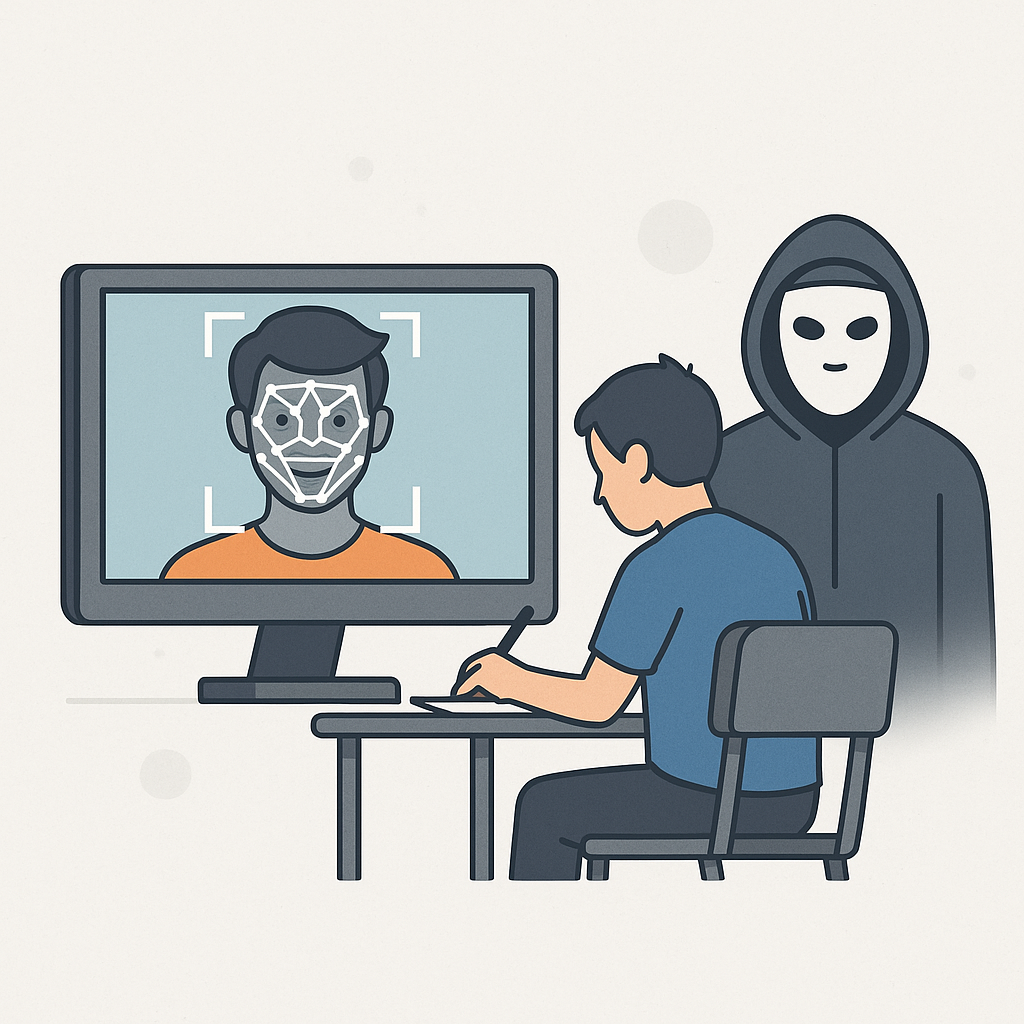
- A proxy can overlay a synthetic face that resembles the legitimate candidate on top of their own webcam feed.
- Low‑quality lighting, small video windows, and compressed streams can hide many of the visual artifacts that would otherwise give the deepfake away.
- With enough source images (e.g., social media profiles, institutional headshots), it’s possible to build convincing models for key facial angles.
Even if your system doesn’t support fully real‑time deepfake streaming, pre‑generated synthetic video segments can be spliced into “verification” moments where the candidate is expected to stay mostly still and look at the camera.
2.2 Voice cloning to pass oral checks and interviews
Some proctoring workflows and oral assessments rely on brief live interactions:
- Proctors may ask the candidate to read a phrase.
- Instructors may conduct short oral exams or viva‑style defenses.
- Programs may use recorded video responses or asynchronous interviews.
Voice cloning allows a proxy to:
- Sound like the registered candidate, using a cloned model driven by the proxy’s speech.
- Maintain consistency across multiple assessment touchpoints (application interview, demo lesson, oral exam) even when different people are actually speaking.
As generative audio models improve, the window for detecting timbre, accent, or prosody inconsistencies narrows—especially when audio quality is degraded by consumer‑grade microphones and noisy home environments.
2.3 Coordinated proxy‑testing operations
Deepfakes and voice clones are rarely used in isolation. They are typically part of a stack of tools used by professional proxy testers:
- Data brokers or insiders obtain candidate details and past exam materials.
- Operators coach candidates on how to behave on camera while a hidden helper solves questions.
- Proxies leverage AI‑assisted research tools, screen sharing, and multi‑monitor setups to answer items quickly and confidently.
The result: a fraud pattern that looks “clean” to naïve monitoring—no obvious glances off screen, no visible phones—yet systematically compromises the validity of your scores.
3. Why Traditional Proctoring Alone Is Not Enough
Online proctoring vendors have made real progress: multi‑camera views, browser lockdown, identity checks, and human‑in‑the‑loop review all raise the bar for casual cheaters. But AI‑enabled fraud exposes several weaknesses when institutions rely solely on legacy approaches.
3.1 Single‑channel monitoring is easy to bypass
If your security model assumes:
- one front‑facing webcam feed,
- one audio channel,
- and minimal telemetry from the candidate’s device,
then a well‑prepared proxy can route that single channel through their own deepfake/voice‑cloning rig and keep the rest of their environment off camera.
3.2 Static rules struggle with adaptive adversaries
Rule‑based triggers—“looked away for X seconds,” “background noise above threshold,” “multiple faces detected”—were designed for older behaviors (notes, visitors, phones). They are far less effective when:
- The visible “candidate” is a consistent synthetic persona.
- The proxy has rehearsed natural eye movements and posture.
- AI tools allow them to answer quickly without obviously searching.
3.3 Human reviewers can’t see what the data doesn’t record
Human‑led proctoring remains critical for context and judgment, but even experienced proctors are limited:
- They see what the cameras and tools show them—no more.
- They may not be trained to recognize subtle signs of deepfake artifacts.
- They can be overwhelmed by volume, especially when reviewing recordings at scale.
To detect AI‑enabled fraud, you need data layers that are invisible to the naked eye and analytics that can surface anomalies across thousands of sittings, not just one.
4. A Multi‑Layered Defense Against AI‑Driven Cheating
You cannot “patch” deepfakes and proxy testers with a single feature. What works is a defense‑in‑depth strategy that accepts adversaries will evolve and builds resilience at multiple levels.
4.1 Strengthen identity assurance—beyond a one‑time selfie
Move from one‑time ID checks to continuous identity assurance:
- Document + biometric verification at registration, not just at exam time.
- Multi‑factor identity (institutional SSO, device fingerprinting, and behavioral profiles).
- Periodic random liveness challenges that require unpredictable responses (e.g., “show me your student card and touch your left ear”) which are harder to pre‑render in deepfakes.
- Cross‑exam consistency checks: monitor whether the “candidate” suddenly appears with a different face/voice profile or behavioral pattern across attempts.
The goal is to make it expensive for a fraudster to maintain a synthetic persona across multiple touchpoints.
4.2 Use multi‑angle and environmental context
Several vendors now emphasize multi‑angle cameras—such as a 360° view of the room or a secondary device (phone) placed behind the candidate. This helps:
- Reduce blind spots where proxies, second screens, or hidden helpers could operate.
- Provide context for AI models and human reviewers: is someone else in the room? Is there an off‑camera monitor?
The key is to combine these views with analytics rather than simply recording more footage. More video without better analysis just increases review burden.
4.3 Build exam security analytics, not just alerts
Modern exam security requires analytics at scale, not just flag generation. Effective programs monitor:
- Unusual success patterns (e.g., clusters of perfect scores on the hardest items).
- Timing anomalies (e.g., unrealistically fast responses on complex questions).
- Geographic and network patterns (e.g., many “candidates” routing through the same IP ranges or locations associated with proxy services).
- Item performance drift (e.g., sudden drops in item difficulty that may indicate content exposure).
Instead of looking only for behaviors in a single sitting, your system should view every exam as one data point in a larger integrity model—similar to how credit card fraud detection works.
4.4 Align policy, technology, and consequences
Technology is only one part of the story. Deepfake‑enabled cheating thrives where:
- Policies are vague or outdated.
- Consequences are inconsistent.
- Communication to students and candidates is limited.
A robust framework should include:
- Clear definitions of prohibited behaviors (proxy testing, synthetic identities, AI tool misuse).
- Transparent communication about monitoring, data use, and privacy safeguards to maintain trust.
- Documented escalation paths when fraud is suspected, including independent review and right of appeal.
- Continuous improvement: lessons from each incident should feed back into policies and analytics.
5. Designing Assessments That Are Resilient to AI‑Driven Cheating
While security controls are essential, the most sustainable defense is to design assessments that are inherently harder to game—even if someone has access to AI tools or outside help.
5.1 Emphasize higher‑order skills over recall
Assessment designs that focus on:
- application,
- synthesis,
- argumentation,
- and decision‑making in context
are more resistant to “copy‑paste” cheating and generic AI assistance. For example:
- Case‑based questions that require reasoning through a scenario.
- Data‑driven tasks where candidates must interpret and justify their conclusions.
- Multi‑step problems where the reasoning path matters, not just the final answer.
5.2 Use dynamic and adaptive elements
Deepfakes and proxy testers work best when the test is predictable and static. You can raise the bar by:
- Employing large item banks with randomized forms.
- Using parameterized questions (same structure, different data).
- Introducing adaptive routing, where the next question depends on previous responses.
This doesn’t make cheating impossible, but it makes sharing exact content and rehearsed answers much less effective.
5.3 Blend online and offline evidence
For truly high‑stakes decisions, consider hybrid models:
- Online proctored exams for standardized measurement.
- Follow‑up oral defenses, project reviews, or performance tasks.
- Portfolio components that showcase sustained work over time, not just a single sitting.
These blended approaches create multiple evidence points that are much harder for organized fraud rings to fully control.
6. What Leaders Should Do Now
Deepfakes, voice cloning, and proxy testers are not a distant “future risk.” They are already reshaping the exam security landscape. Waiting for a perfect technical solution is not an option.
If you’re responsible for assessment integrity in your institution or program, consider the following next steps:
1. Audit your current threat model
Map out exactly how identity is verified, how monitoring works, what data is collected, and where blind spots exist—especially around identity continuity and analytics.
2. Prioritize multi‑layered defenses
Invest in capabilities that complement each other: stronger identity assurance, multi‑angle monitoring, and analytics that look across cohorts and time, not just individual exams.
3. Modernize your policies
Update your integrity policies to explicitly cover synthetic media, AI assistance, and organized proxy testing. Ensure they are communicated clearly to candidates and staff.
4. Collaborate across stakeholders
Security teams, faculty, instructional designers, and proctoring vendors should treat exam integrity as a shared responsibility. Align on goals, evidence standards, and escalation procedures.
5. Plan for continuous evolution
Just as fraud techniques will evolve, your defenses must be iterative. Build feedback loops from incidents, analytics, and user experience into your roadmap.
By treating deepfakes and proxy testers not as edge cases but as core design constraints, you can build an assessment ecosystem that remains trustworthy—even as AI reshapes what cheating looks like.
FAQs
What is a deepfake in the context of online exams?
A deepfake in online exams is a synthetic video, often generated with AI, that makes a proxy tester look like the registered candidate on camera. It can be used during identity verification or throughout the exam session to bypass proctoring and facial recognition checks.
How does voice cloning affect exam integrity?
Voice cloning lets a proxy tester speak while sounding like the real candidate. This can be used to pass oral exams, interviews, or spoken proctor challenges that rely on recognizing the candidate’s voice, making it harder to confirm who is actually taking the assessment.
Can traditional webcam proctoring detect AI‑enabled cheating?
Basic webcam proctoring can catch obvious behaviors—like someone else entering the room or a candidate constantly looking off‑screen—but it struggles with sophisticated deepfakes, voice clones, and coordinated proxy operations. Without multi‑angle views and robust analytics, many AI‑enabled fraud attempts will look ‘normal’ to both AI and human reviewers.
What role do exam security analytics play against deepfakes and proxy testers?
Exam security analytics aggregate data across sessions—timing, item performance, location, network patterns, and more—to spot anomalies that humans might miss. For example, they can highlight clusters of near‑perfect scores on hard items, unusual completion times, or multiple ‘candidates’ coming from the same environment associated with proxy services.
How can institutions make exams more resistant to AI‑assisted cheating?
Institutions can design assessments that focus on higher‑order thinking, use large and randomized item banks, incorporate adaptive testing, and blend proctored exams with oral defenses or project work. These approaches make it harder for AI tools and proxy testers to simply ‘plug in answers’ without genuinely understanding the material.
Are deepfakes and voice cloning only a concern for high‑stakes exams?
They are most attractive where the reward is high—licensure, professional credentials, major degree milestones—but the same techniques are starting to appear in course‑level assessments, remote interviews, and even placement tests. Programs should consider the risk–reward balance and scale their defenses accordingly.
What should an institution do if it suspects deepfake‑enabled fraud?
First, preserve all available evidence: video streams, logs, item data, and communications. Then follow a documented escalation process that includes independent review, consultation with your proctoring or assessment security provider, and clear communication with the candidate. Use the incident to update your threat model, analytics rules, and staff training.